
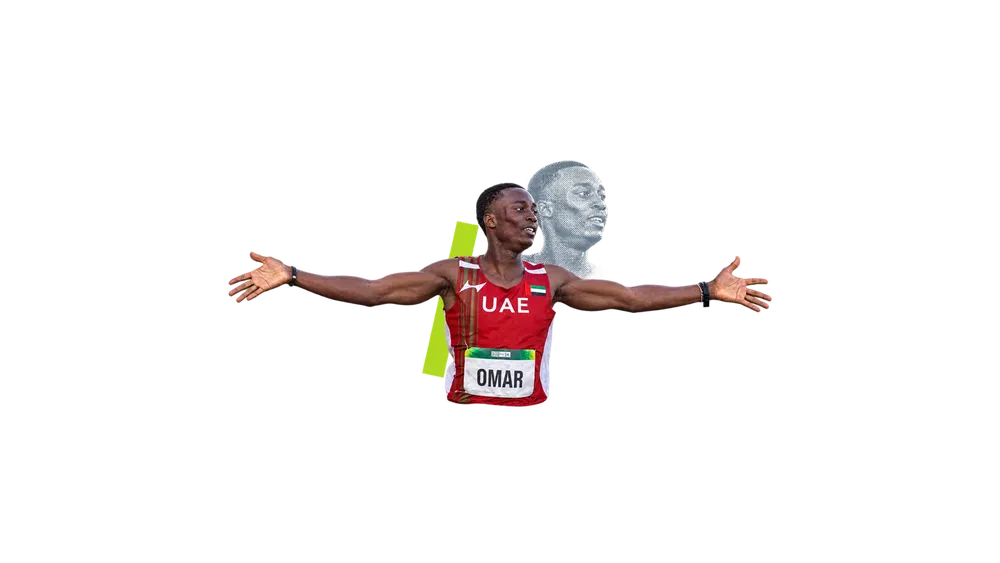
Saeed Omar went into the men’s 400m final in Dakar with a personal best of 47.10 seconds. By the time Monday’s race was over, he had lowered it to 46.40 and become the UAE’s first athletics champion at the Youth Olympic Games. The gold medal was the most conspicuous reward, but the improvement on the clock gave him another reason to value the evening.
Omar finished more than half a second ahead of Gambia’s Mustapha Jadama, who took silver in 46.93, with China’s Han Liu third in 47.16. Aisha Mohammed added bronze in the women’s 400m, also with a personal best. After Arwa Ali’s silver in the 100m the previous day, all three members of the UAE athletics team had reached the podium.
That is a considerable return from a small group. The two medals on Monday took the UAE’s official Dakar total to four, following Riyan Malhan’s badminton gold earlier in the Games. Athletics supplied one of each colour, with the results spread across the men’s and women’s races rather than resting on one outstanding individual. For the federation, there are now three performances to assess and three runners whose next steps deserve attention.
Omar had qualified by winning his semi final in 48.33. He was third fastest across the two races, a position that offered a route to the medals without making the title inevitable. His final was almost two seconds quicker, although the more useful comparison is with the 47.10 he brought into the competition. Taking seven tenths off that mark while winning a global youth final gives the result a substance that extends beyond where he finished.
Mohammed’s race produced a much closer contest for the medals. Nigeria’s Praise Ugoh won in 52.76, Venezuela’s Osmary Pacheco followed in 52.85 and the Emirati runner finished in 53.06. Three tenths of a second covered the podium. Mohammed was 1.93 seconds clear of Slovenia’s Neli Kramaršek in fourth, leaving a substantial gap between the leading three and the rest of the field.
Her bronze also followed an improvement between rounds. A time of 54.89 had taken her through the semi finals, before she found another 1.83 seconds in the deciding race. The personal best matters alongside the narrow distance to gold: she met the stronger demand of the final with her fastest recorded performance, even though two rivals were quicker. It is a useful achievement to carry into the next stage of her development.
Ali had begun the athletics team’s medal run on Sunday, finishing between Nigeria’s Rosemary Nwankwo and Qatar’s Dana Salem in the 100m. Her 11.41 brought silver, behind Nwankwo’s 11.16 and ahead of Salem’s 11.48. The race had a following wind of 2.4 metres per second, above the limit for record purposes, so the time should not be treated in the same way as the personal bests from the 400m finals.
The placing remains significant. Ali became the first Emirati woman to win a medal in the official Youth Olympic programme, adding to the 100m title she won at the Asian Youth Games in Bahrain last year. Her progress from that regional victory to a global youth podium gives the UAE a concrete example of a runner sustaining competitive success across different championships. With Salem alongside her in bronze, the final also brought two Gulf countries into the medals.
Dakar has already changed the UAE’s record at these Games. Before this edition, its only medal had been Omar Al Marzooqi’s showjumping silver in Buenos Aires in 2018. Malhan secured the first gold on November 5 by beating France’s Mady Sow in the boys’ singles badminton final. The three athletics medals then widened a success that had initially belonged to one sport.
The country sent 12 athletes across nine sports, its largest Youth Olympic delegation. That scale makes the athletics return particularly welcome, while also keeping it in perspective. Three medal winners provide an encouraging group to develop, but a broader supply of competitive athletes will take more than one successful meeting. The immediate task is to help these runners keep improving and give others opportunities to reach a similar level.
The UAE Olympic Committee has described a preparation programme that includes identifying talent, international competition, physical and psychological preparation, medical support and nutrition. Those are practical areas in which the value of Dakar can continue after the medals are put away. The athletes have provided evidence of what they can do now; maintaining the support around them will matter as the fields become older and more demanding.
There is still competition ahead in Senegal before the Games close on Friday. Boxer Moaz Wael won his 70kg quarter final against Ghana’s Robert Amartey on Tuesday by a four to one decision, guaranteeing at least a bronze medal. He is scheduled to face Britain’s Michael Maughan in Wednesday’s semi final. The UAE’s week has further possibilities, even as its athletics team can reflect on a completed programme.
For Omar, Mohammed and Ali, the distinction is already clear. Each arrived with a place in a small national team and leaves the competition with a medal. Omar’s 46.40 gives that collective achievement its strongest result, and a precise mark from which to begin again when the next season comes.
Get the free Friday briefing for more stories from Gulf sport.